Learning to Look 2026

January 22, 2026
Learning to Look | Pre-Columbian Mexico
From the Olmec to the Aztecs, Mexico holds nearly 3,000 years of rich cultural history. From the rainforests of the south to the central highlands, civilizations rose, built monumental works, and eventually faded—each with its own story, yet connected through shared themes and enduring traditions. Explore the art and architecture of Mesoamerica through sculpture, painting, and sacred sites, and consider this vast timeline alongside Europe’s—from the ancient Minoans through the High Renaissance.
Guest Lecturer: Thomas Germano, Professor of Art History at Farmingdale State College, and two-time NEA grant recipient for the study of Mesoamerican art history and culture.
Register at the link below:
https://form.jotform.com/253525425951156
*ZOOM link for each talk is the same.

February 19, 2026
Learning to Look | Mexico: 1526–2026 | Post-Contact to Present
After three centuries of Spanish rule, Mexico gained independence in 1821. From the arrival of Cortés through the modern era, Mexican art and culture have evolved through cycles of westernization, hybridization, and revival. This session will explore early codices, Baroque architecture, the rise of modernism, Mexican Muralism, and contemporary developments that continue to shape Mexico’s visual culture today.
Guest Lecturer: Thomas Germano, Professor of Art History at Farmingdale State College, and two-time NEA grant recipient for the study of Mesoamerican art history.
Register at the link below:
https://form.jotform.com/253525425951156
*ZOOM link for each talk is the same.

March 12, 2026
Learning to Look | Georgia O’Keeffe and the Transcendental Painting Group
Georgia O’Keeffe first traveled to Taos, New Mexico, in 1929, where she encountered a circle of like-minded abstractionists who would become the Transcendental Painting Group. Among the artists associated with this movement were Raymond Jonson, Emil Bisttram, and Agnes Pelton. This presentation traces the parallel paths of O’Keeffe and her contemporaries, examining early modernist influences and the impact of the Southwest’s bright skies and stark landscapes on their work in the 1930s and ’40s.
Register at the link below:
https://form.jotform.com/253525425951156
*ZOOM link for each talk is the same.
In person at 20 Terry Street, Patchogue or on ZOOM Meeting ID: 880 1524 8901 | Passcode: 419010

April 23 @ 6:30 PM
Learning to Look | The Birth of Abstraction
In this three-part series, we will explore the development of modernism across a nearly thirty-year period beginning in 1886—tracing pivotal shifts from Post-Impressionism through Expressionism, and culminating in the explosion of Cubism in the years leading up to World War I.
Register at the link below:
https://form.jotform.com/260564121284149
*ZOOM link for each talk is the same.
In person at 20 Terry Street, Patchogue or on ZOOM Meeting ID: 880 1524 8901 | Passcode: 419010

May 21 @ 6:30 PM
Learning to Look | Post-Impressionism
At the height of the Impressionist movement, a number of artists began seeking new approaches, ushering in the next major development in European modernism: Post-Impressionism. The artists who came to be known as Post-Impressionists did not share a single collective style; rather, they pursued individual paths that extended—and challenged—the aims of Impressionism in service of their own artistic visions. Chief among these voices were Paul Cézanne, Paul Gauguin, Georges Seurat, and Vincent van Gogh. Their innovations would profoundly shape the art of the 20th century.
Register at the link below:
https://form.jotform.com/260565008140145
*ZOOM link for each talk is the same.
In person at 20 Terry Street, Patchogue or on ZOOM Meeting ID: 880 1524 8901 | Passcode: 419010

June 11 @ 6:30 PM
Learning to Look | Expressionism
Born in the final years of the 19th century amid rapid industrialization, Expressionism became the first major art movement of the 20th century. Building on key Post-Impressionist innovations—Paul Gauguin’s liberated color, Vincent van Gogh’s energetic brushwork, and Paul Cézanne’s structural approach to composition—Expressionism embraced emotion and intensity as central artistic aims, helping to define a new century. Early pioneers included the French Fauves, led by Henri Matisse, and Der Blaue Reiter (The Blue Rider), associated with Wassily Kandinsky.
Register at the link below:
https://form.jotform.com/260564182076155
*ZOOM link for each talk is the same.
In person at 20 Terry Street, Patchogue or on ZOOM Meeting ID: 880 1524 8901 | Passcode: 419010
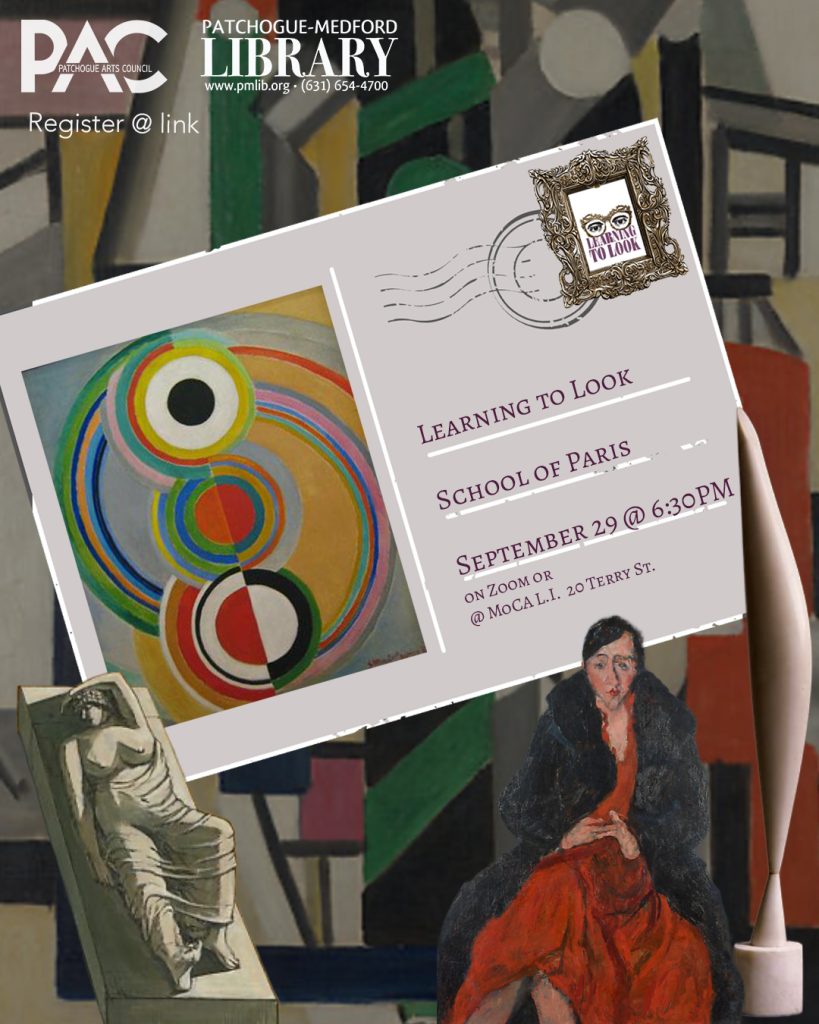
September 29, 2026 @ 6:30 PM
Learning to Look | School of Paris
The School of Paris describes French figurative art after World War One. The war had a significant impact on the course of modern art. Many of the most progressive artists reevaluated the direction their work would take, reverting from deep abstraction to figuration. Chief among them were Henri Matisse and Pablo Picasso.
In person at MoCA L.I. 20 Terry Street, Patchogue
or on ZOOM Meeting ID: 880 1524 8901 | Passcode: 419010
Register at the link below:
https://form.jotform.com/262456617472160
Learning to Look is presented in partnership with the Patchogue – Medford Library
